
Blind Soccer is a unique adaptation of the beloved sport, designed specifically for athletes with visual impairments, including those who are blind. Governed by the International Football Sports Federation (IBSA), this game adheres to modified FIFA rules and holds its place in the Paralympics since its inclusion in 2004.
Unlike traditional soccer, blind soccer features a smaller field of play, enclosed by boards to keep the action contained. The distinctive ball used in this game is equipped with a noise-making device, aiding players in tracking its movement through sound cues.
Each team comprises five players, including a goalkeeper, with an additional guide stationed off the field of play to assist in directing the players. Interestingly, teams have the option to enlist sighted goalkeepers, enhancing the tactical aspect of the game.
Blind soccer matches are structured into two 25-minute halves, separated by a ten-minute halftime interval. This format not only accommodates the unique needs of visually impaired players but also ensures an exciting and competitive sporting experience for all involved.
In the world of soccer, individuals with hearing impairments encounter unique challenges that often go unnoticed. They grapple with the inability to hear their coach’s instructions during a game, the referee’s decisions, or the exuberant cheers of the crowd.
To participate in deaf soccer competitions on an international level, players must meet specific hearing criteria. According to these criteria, players are required to have an average hearing loss of 55 Decibels or greater in their best ear. Research indicates that hearing loss below this threshold can significantly hinder their ability to perceive sound accurately, underscoring the need for such criteria in the sport.
Power Soccer stands as a groundbreaking team sport meticulously crafted for the unique abilities of power wheelchair users. Athletes who embrace this dynamic sport span a spectrum of disabilities, including multiple sclerosis, quadriplegia, muscular dystrophy, cerebral palsy, and more.
In Power Soccer, players harness the agility and mobility of their wheelchairs as they navigate the court. Wheelchairs become a versatile tool for passing the ball, executing tactical manoeuvres against opponents, and ultimately, delivering precise shots on goal.
These thrilling matches typically unfold indoors, typically on a specially adapted basketball court, tailored to accommodate the sport’s unique dynamics. The soccer ball itself is slightly larger than the standard regulation-sized version, ensuring that it can be effectively manipulated by players using their wheelchairs.
Each riveting contest features two teams, each comprising four players, who skillfully employ their wheelchairs to propel the soccer ball across the court. Power Soccer’s ingenious design not only showcases the capabilities of power wheelchair users but also fosters a thrilling, inclusive, and competitive sporting experience that transcends traditional notions of athleticism.
Frame Soccer caters to individuals who rely on walkers or crutches for their daily mobility. This inclusive sport accommodates participants of all ages, spanning both children and adults, providing them with an opportunity for active engagement.
Originating in England in 2014, Frame Soccer has rapidly gained recognition and popularity, exemplifying the power of sports to transcend physical limitations and foster a sense of community and achievement among its players.
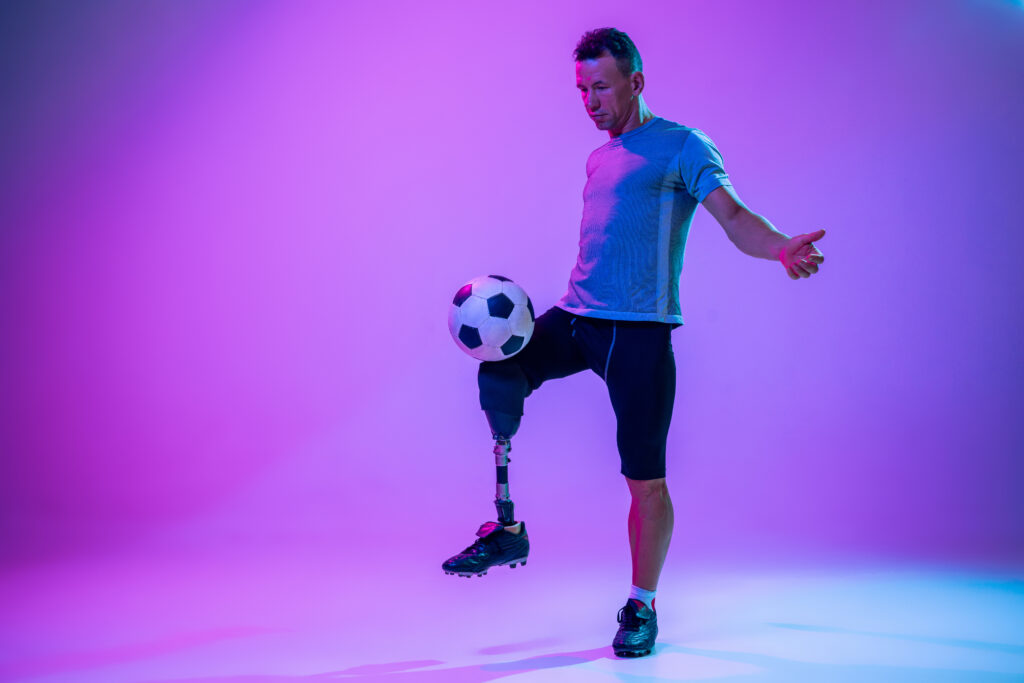 In 2005, the World Amputee Football Federation was established during a World Congress held in Brazil. This historic moment brought together founding members from diverse nations, including Argentina, Brazil, England, Russia, Ukraine, the United States, and Uzbekistan.
Since its inception, the Federation has flourished, now boasting over 30 national associations representing five continents. The sport typically involves matches with six players on each side, along with a goalkeeper. Players traverse the field using standard crutches, with the stipulation that prosthetic limbs are not allowed.
Notably, in 2014, the U.S. National Amputee Soccer Team achieved a significant milestone by qualifying for the World Cup after more than a decade of absence.
Founded in 1968, the Special Olympics stands as the world’s preeminent sports organization dedicated to providing year-round training and competitions for children and adults with intellectual disabilities. These events are distinct from the mainstream Olympics and the Paralympics.
Special Olympic Soccer encompasses a range of formats, including 5-a-side, 7-a-side, and 11-a-side competitions. These inclusive sporting initiatives offer individuals with intellectual disabilities the opportunity to engage in athletic activities, fostering their physical and mental well-being while promoting the values of unity, inclusion, and sportsmanship.
Dwarf Soccer is a sporting platform tailored for athletes of shorter stature. The administration and coordination of this sport in the United States are overseen by the Dwarf Athletic Association of America (DAAA), which extends an open invitation to athletes of all skill levels. The DAAA actively orchestrates a spectrum of events, ranging from recreational and developmental to elite-level competitions, ensuring inclusivity and accessibility for all participants.
The pinnacle of competitive Dwarf Soccer is the World Dwarf Games, a quadrennial event that assembles athletes from across the globe. The most recent edition of these games transpired in 2017, hosted in Ontario, Canada. In earlier years, notable host cities included Chicago in 1993 and East Lansing, Michigan, in 2013, reflecting the global appeal and recognition of Dwarf Soccer.
Furthermore, it is noteworthy that Dwarf Soccer holds a significant presence within the USSF Disability Committee, further solidifying its standing as a recognized and respected component of the broader soccer community.